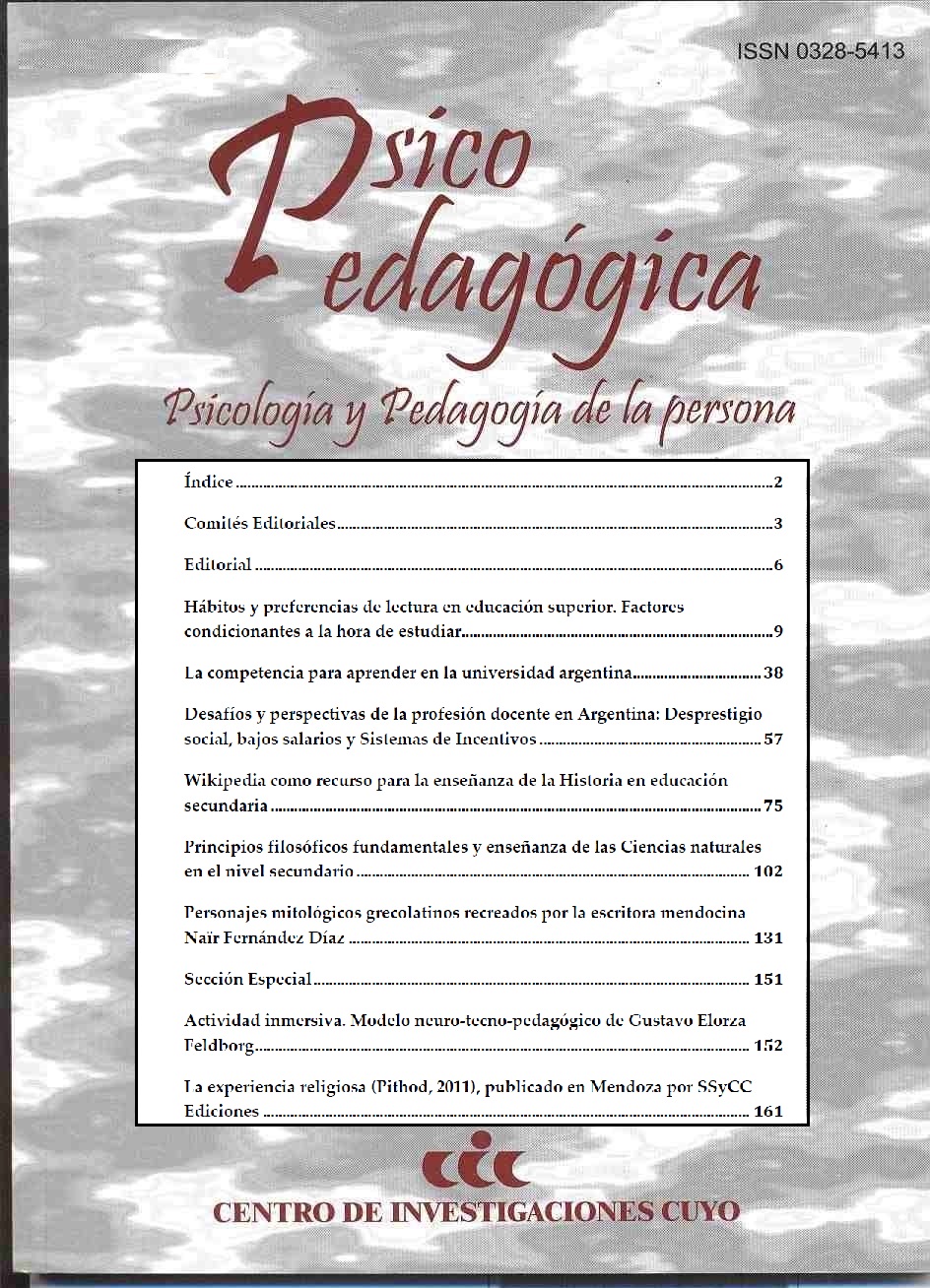
Hábitos y preferencias de lectura en educación superior.
Factores condicionantes a la hora de estudiar
Resumen
El presente artículo muestra los primeros hallazgos obtenidos en el marco del proyecto de investigación bianual 2023-2024 denominado “Hábitos de lectura y aceptación tecnológica en los estudiantes de la Universidad del Aconcagua”. El propósito de este proyecto es explorar, relevar y analizar los hábitos de lectura de la comunidad estudiantil de esta universidad y el grado de aceptación tecnológica. La muestra involucró a 1062 estudiantes de las carreras de pregrado, grado y posgrado de todas las unidades académicas durante el ciclo lectivo 2023. Se analizó los distintos recursos bibliográficos que son utilizados por los estudiantes, tanto impresos como digitales. Entre los hallazgos se destacan algunas discrepancias entre los formatos favoritos y aquellos que se emplean con mayor frecuencia. Los resultados sugieren que los estudiantes alternan entre distintos formatos dependiendo de la tarea que desean completar, ya sea buscar información, tomar apuntes o estudiar
Citas
Ackerman, R., y Goldsmith, M. (2011). Metacognitive regulation of text learning: On screen versus on paper. Journal of Experimental Psychology: Applied, 17(1), 18–32. https://doi.org/10.1037/a0022086
Albarello, F. (2019). El lector en la encrucijada: la lectura/navegación en las pantallas digitales. Cuadernos del Centro de Estudios en Diseño y Comunicación. Ensayos, (72), 32-42. https://dx.doi.org/10.18682/cdc.vi72.1100
Al-Sulaimi, A., y Al-Shihi, H. (2017). The effects of reading mode (digital vs printed text) on reading comprehension: A literature review of the key assessment factors. In 2017 6th International Conference on Information and Communication Technology and Accessbility, ICTA 2017 (pp. 1-6). Article 8336053 (2017 6th International Conference on Information and Communication Technology and Accessbility, ICTA 2017; Vol. 2017-December). Institute of Electrical and Electronics Engineers Inc. https://doi.org/10.1109/ICTA.2017.8336053
Baron, N. S. (2015). Words onscreen: The fate of reading in a digital world. Oxford University Press.
Bresó-Grancha, N.; Río-Carmona, M. D.; Mora-Roda, C.; Jorques-Infante, M. J. y Moret-Tatay, C. (2023). Perfiles sobre tiempo de lectura y comprensión de textos impresos y digitales en estudiantes universitarios. Nereis. Interdisciplinary Ibero-American Journal of Methods, Modelling and Simulation, (14). https://doi.org/10.46583/nereis_2022.1.1038
Carmel, E.; Crawford, S. y Chen, H. (1992). Browsing in hypertext: A cognitive study. IEEE transactions on Systems, Man, and Cybernetics, 22(5), 865-884. https://doi.org/10.1109/21.179829
Carr, N. (2010). The shallows: How the internet is changing the way we think, read, and remember. Atlantic Books Ltd.
Cassany, D.; Luna, M. y Sanz, G. (1994). Enseñar lengua. Graó. Barcelona.
Charmaz, K. (2014). Constructing Grounded Theory (2nd ed.). Sage.
Cordón García, J. (2018). Libros electrónicos y lectura digital: los escenarios del cambio. Palabra Clave, 7(2), e044.
https://www.memoria.fahce.unlp.edu.ar/art_revistas/pr.8536/pr.8536.pdf
Cove, J. F. y Walsh, B. C. (1988). Online text retrieval via browsing. Information processing y management, 24(1), 31-37. https://doi.org/10.1016/0306-4573(88)90075-1
De Castro Daza, D. P. y Niño Gutiérrez, R. M. (2014). Tendencias sobre las prácticas de lectura y escritura en la universidad colombiana: el punto de vista de los estudiantes. Diversitas: Perspectivas en Psicología, 10(1), 71-85. https://doi.org/10.15332/s1794-9998.2014.0001.05
Fidler, R. (1998). Mediamorfosis. Comprender los nuevos medios. Granica.
Fu, W.T. y Pirolli, P. (2007). SNIF-ACT: A Cognitive Model of User Navigation on the World Wide Web. Human–Computer Interaction, 22(4), 355–412.
https://doi.org/10.1080/07370020701638806
Gąsior, K. E. (2019). E-texts or p-texts? Evidence from reading comprehension tasks for Polish teen-age learners of English. Lublin Studies in Modern Languages and Literature, 43(4), 127-146. https://doi.org/10.17951/lsmll.2019.43.4.127-146
Gómez, H. O. S. y Vallecillo, E. d. l. Á. V. (2021). Lectura fragmentada: una estrategia de aprendizaje en la era digital. Revista Torreón Universitario, 10(27), 26-36.
https://doi.org/10.5377/torreon.v10i27.10837
Hernández Sampieri, R.; Fernández, C. y Baptista Lucio, P. (2018). Metodología de la investigación (6a ed.). McGraw Hill Interamericana.
Hillesund, T. (2010). Digital reading spaces: How expert readers handle books, the Web and electronic paper. First Monday, 15(4). https://doi.org/10.5210/fm.v15i4.2762
Hou, J.; Rashid J. y Lee, K. (2017). Cognitive map or medium materiality? Reading on paper and screen. Computers in Human Behavior, (67), 84-94. https://doi.org/10.1016/j.chb.2016.10.014
Kazanci, Z. (2015). University Students’ Preferences of Reading from a Printed Paper or a Digital Screen ― A Longitudinal Study. International Journal of Culture and History, 1(1), 50-53. https://doi.org/10.18178/ijch.2015.1.1.009
Kobayashi, M. (2017). Students’ media preferences in online learning. Turkish Online Journal of Distance Education-TOJDE, 18(3), Article 1. https://files.eric.ed.gov/fulltext/EJ1147585.pdf
Larhmaid, M. (2018). The Impact of Print vs. Digital Resources on Moroccan University Students’ Reading Habits, Uses, and Preferences (October 16, 2018). SHS Web of Conferences 52, 02001 (2018). https://ssrn.com/abstract=4326150
Liao, S.; Yu, L., Kruger, J. y Reichle, E. D. (2023). Dynamic reading in a digital age: new insights on cognition. Trends in Cognitive Sciences, 28(1), 43–55.
https://doi.org/10.1016/j.tics.2023.08.002
Liu, Z. (2005). Reading behavior in the digital environment: Changes in reading behavior over the past ten years. Journal of Documentation, 61(6), 700-712.
https://doi.org/10.1108/00220410510632040
Loayza-Maturrano, E. F. (2022). Preferencias y hábitos de lectura en estudiantes universitarios. Revista ConCiencia EPG, 7(1), 36-50. https://doi.org/10.32654/CONCIENCIAEPG.7-1.3
Loh, C. E. y Sun, B. (2019). “I'd still prefer to read the hard copy”: Adolescents’ print and digital reading habits. Journal of Adolescent y Adult Literacy, 62(6), 663-672.
https://doi.org/10.1002/jaal.904
McLuhan, M. (2009). Comprender los medios de comunicación: Las extensiones del ser humano. Paidós Ibérica.
McLuhan, E. y Zingrone, F. (1998). McLuhan escritos esenciales. Paidós.
Mangen, A. (2008). Hypertext fiction reading: haptics and immersion. Journal of Research in Reading, 31(4), 404-419. https://doi.org/10.1111/j.1467-9817.2008.00380.x
Mangen, A.; Walgermo, B. R. y Brønnick, K. (2013). Reading linear texts on paper versus computer screen: Effects on reading comprehension. International Journal of Educational Research, (58), 61-68. https://doi.org/10.1016/j.ijer.2012.12.002
Martos García, A. E. (2009). Tecnologías de la Palabra en la era digital: de la cultura letrada a la cibercultura. RELATEC: Revista Latinoamericana de Tecnología Educativa, 8(2), 15-37. https://dialnet.unirioja.es/servlet/articulo?codigo=3160925
Morduchowicz, R. (2021a). Adolescentes, participación y ciudadanía digital. Fondo de Cultura Económica de Argentina. https://elibro.net/es/lc/uda/titulos/219062
Morduchowicz, R. (2021b). Los adolescentes del siglo XXI: los consumos culturales en un mundo de pantallas. Fondo de Cultura Económica de Argentina.
https://elibro.net/es/lc/uda/titulos/219387
Morduchowicz, R. (2021c). Los adolescentes y las redes sociales: la construcción de la identidad juvenil en internet. Fondo de Cultura Económica de Argentina.
https://elibro.net/es/lc/uda/titulos/219388
Morduchowicz, R. (2021d). Los chicos y las pantallas: las respuestas que todos buscamos. Fondo de Cultura Económica de Argentina. https://elibro.net/es/lc/uda/titulos/219373
Morduchowicz, R. (2013). Los adolescentes del siglo XXI. Fondo de Cultura Económica
Ossa, A. (2020). Editorial. En Kovač, M. y van der Weel, A. (Eds.), Lectura en papel vs. lectura en pantalla (pp. 5). Centro Regional para el Fomento del Libro en América Latina y el Caribe (CERLALC)-Unesco. https://cerlalc.org/wp-content/uploads/2020/04/Cerlalc_ Publicaciones_Dosier_Pantalla_vs_Papel_042020.pdf
Palmer, E. (2015). Researching in a Digital World: How do I teach my students to conduct quality online research? ASCD.
Panchu, P.; Bahuleyan, B. y Seethalakshmi (2016). The role of metacognitive awareness of reading strategies as a predictor of academic achievement. International Journal of Advanced Research, 4(11), 720-725. http://dx.doi.org/10.21474/IJAR01/2137
Parodi, G.; Moreno-de León, T.; Julio, C. y Burdiles, G. (2019). Generación Google o Generación Gutenberg: Hábitos y propósitos de lectura en estudiantes universitarios chilenos. Comunicar. Revista Científica de Comunicación y Educación, (58), 85-94.
https://doi.org/10.3916/C58-2019-08
Rosa, M. (2017). Educating the next generation of teachers: 21st century skills, research and ICT competencies through PBL. Avances en Educación y Humanidades, 2(2), 31-43. https://doi.org/10.21897/25394185.1483
Schmidt, F. y Retelsdorf, J. (2016). A New Measure of Reading Habit: Going Beyond Behavioral Frequency. Frontiers in Psychology, (7), Article 1364.
https://doi.org/10.3389/fpsyg.2016.01364
Sparrow, B.; Liu, J. y Wegner, D. (2011). Google Effects on Memory: Cognitive Consequences of Having Information at Our Fingertips. Science, 333(6043), 776-778.
https://doi.org/10.1126/science.1207745
Stok, M. F. (2018). Las prácticas lectoras en textos análogos y textos digitales, un estudio en educación superior de lecto-comprensión en el idioma inglés. Traslaciones. Revista Latinoamericana de Lectura y Escritura, 5(10), 238-262.
https://revistas.uncu.edu.ar/ojs/index.php/traslaciones/article/view/1623
Subrahmanyam, K.; Michikyan, M.; Clemmons, C.; Carrillo, R.; Uhls, Y. T. y Greenfield, P. M. (2013). Learning from Paper, Learning from Screens. International Journal of Cyber Behavior, Psychology, and Learning, 3(4), 1-27. https://doi.org/10.4018/ijcbpl.2013100101
Umaña, L. V. y Aguilar, L. E. B. (2022). Percepción del estudiantado universitario sobre la virtualización de la enseñanza de la metodología de la investigación científica en la educación superior. Actualidades Investigativas en Educación, 22(3), 1-28. https://doi.org/10.15517/aie.v22i3.50638
Utami, T.; Apriliaswati, R. y Sumarni, S. (2022). A Case Study of a Student’s Reading Habits on Academic Texts. Acitya: Journal of Teaching and Education, 4(2), 436-457. https://doi.org/10.30650/ajte.v4i2.3226
Verplanken, B. y Aarts, H. (1999). Habit, attitude, and planned behaviour: is habit an empty construct or an interesting case of goal-directed automaticity? European Review of Social Psychology, 10(1), 101-134. https://doi.org/10.1080/14792779943000035
Verplanken, B. y Orbell, S. (2003). Reflections on past behavior: a self-report index of habit strength. Journal of Applied Social Psychology, 33(6), 1313-1330. https://doi.org/10.1111/j.1559-1816.2003.tb01951.x
Wolf, M. y Stoodley, C. J. (2018). Reader, come home: the reading brain in a digital world. Harper Collins Publishers.